
Ni alloy 718 wire
UNS N07718 (EN 2.4668, ASTM B637, AWS A5.14 ERNiFeCr-2)
Key Characteristics
- High strength up to ~650 °C and excellent creep/fatigue resistance
- Outstanding corrosion resistance in oxidizing environments
- Good weldability, resistant to post‑weld cracking
- Age‑hardenable to restore strength after fabrication/repair heat cycles
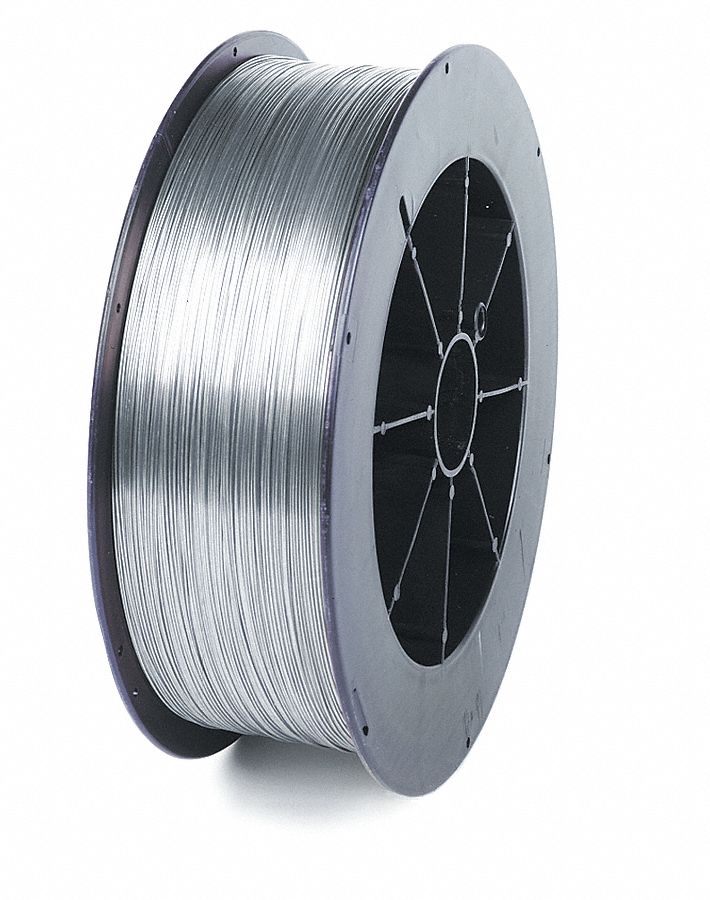
Ni-alloy 718 is a precipitation‑hardened nickel‑chromium alloy strengthened by γ′ (Ni₃(Al,Ti)) and γ″ (Ni₃Nb) precipitates. It offers a balance of high tensile and fatigue strength with corrosion resistance from cryogenic temperatures to ~650 °C.
🏭 Industry Sectors
- Aerospace: engine casings, rings, large fasteners
- Energy: large support structures and vessels
- Oil & Gas: downhole tools, wellhead components
- Industrial: Chemical processing vessels
Composition
| Element | Weight % |
|---|---|
| Ni | Balance |
| Cr | 17 – 21 |
| Fe | 17 – 21 |
| Mo | 2.8 – 3.3 |
| Nb + Ta | 4.75 – 5.5 |
| Ti | 0.65 – 1.15 |
| Al | 0.2 – 0.8 |
| Co | ≤ 1.0 |
| Mn | ≤ 0.35 |
| Si | ≤ 0.35 |
| C | ≤ 0.08 |
Wire sizes
| Size Distribution | Typical Uses |
|---|---|
| 0.8 – 1.2 | Precision WAAM and LW-DED of small components |
| 1.2 – 2.0 | General WAAM, LW-DED, and EBW-DED applications |
| 2.2 – 3.2 | High-deposition DED, large structures |
Heat Treatment – ASM 5663
Stage 1: Solution Treatment
Hold at 985°C for 60 – 120 minutes and cool to below 30°C
Stage 2: Precipitation Hardening (Aging)
Hold at 720°C for 8 hours followed by cooling to 620°C, hold at 620°C for 8 hours, slow cool to below 400°C and then cool to room temperature in air.
Key Materials Properties
| Property Type | Property | Value |
|---|---|---|
| Mechanical | Yield Strength | 820 – 840 MPa |
| Mechanical | Ultimate Tensile Strength | 1050 – 1120 MPa |
| Mechanical | Elongation to break | 20 – 30 % |
| Mechanical | Hardness | ~ 24 HRc |
| Mechanical | High Cycle Fatigue limit | |
| Mechanical | Young’s Modulus | ~202 GPa |
| Mechanical | Fracture toughness | |
| Thermal | Conductivity | ~11.0 W/m·K |
| Thermal | Linear Expansion (20–100°C) | ~12.5 µm/m·°C |
| Electrical | Resistivity @ 20°C |
Corrosion Resistance
Excellent resistance to oxidation and many corrosive environments, including jet engine and marine atmospheres.
Heat Resistance
Maintains high strength and oxidation resistance up to ~650 °
Welding
Common filler: AWS A5.14 ERNiFeCr-2 Processes: Requires low heat input and inert shielding to prevent microfissuring Post-weld ageing restores full strength.
Machining
Difficult to machine due to work hardening and low thermal conductivity. Use rigid setups, sharp tools, and generous coolant.