
Ti6Al4V titanium wire
UNS R56400 (EN 3.7165, AWS A5.16, ERTi-5)
Key Characteristics
- High strength-to-weight ratio with excellent fatigue resistance
- Outstanding corrosion resistance in oxidizing environments
- Good biocompatibility for medical applications
- Requires inert gas shielding or vacuum due to high reactivity
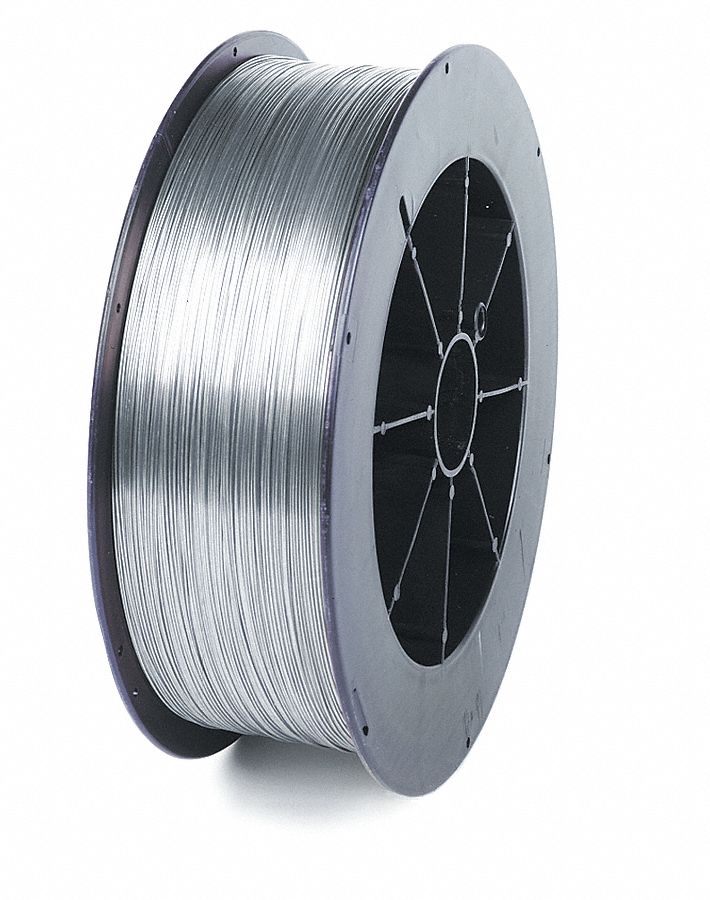
Ti-6Al-4V is the most widely used α+β titanium alloy. It offers an excellent combination of high strength-to-weight ratio, corrosion resistance, and biocompatibility, making it a preferred choice for aerospace, marine, chemical, and biomedical applications. It is commonly used in WAAM (Wire Arc Additive Manufacturing) and wire-fed DED (Directed Energy Deposition) and has already a number of qualified production uses.
🏭 Industry Sectors
- Aerospace: Airframe structures
- Marine: Large offshore and subsea components
- Food industry: Raw product and liquid vessels
- Industrial: Chemical processing vessels
Composition
| Element | Weight % |
|---|---|
| Ti | Balance |
| Al | 5.5 – 6.75 |
| v | 3.5 – 4.5 |
| Fe | ≤ 0.4 |
| O | ≤ 0.2 |
| C | ≤ 0.08 |
| N | ≤ 0.05 |
| H | ≤ 0.015 |
Wire sizes
| Size Distribution | Typical Uses |
|---|---|
| 0.8 – 1.2 | Precision WAAM and LW-DED of small components |
| 1.2 – 2.0 | General WAAM, LW-DED, and EBW-DED applications |
| 2.2 – 3.2 | High-deposition DED, large structures |
Heat Treatment
- Annealing: 700–785 °C for stress relief.
- Solution Treatment: ~950 °C (just below β-transus), followed by water quench.
- Aging: 530 °C for 8 hours to stabilize α+β phases and improve strength.
Note: HIP is often used to ensure closure of internal pores and melt defects, and is usually followed by Solution treatment and aging.
Key Materials Properties
| Property Type | Property | Value |
|---|---|---|
| Mechanical | Yield Strength | 820 – 880 MPa |
| Mechanical | Ultimate Tensile Strength | 890 – 950 MPa |
| Mechanical | Elongation to break | 10 – 14 % |
| Mechanical | Hardness | ~350Hv |
| Mechanical | High Cycle Fatigue limit | 240 MPa typical |
| Mechanical | Young’s Modulus | ~115 GPa |
| Mechanical | Fracture toughness | 75 MPa√m |
| Thermal | Conductivity | ~7.0 W/m·K |
| Thermal | Linear Expansion (20–100°C) | ~8.9 µm/m·°C |
| Electrical | Resistivity @ 20°C | ~1.7 µΩ·m |
Corrosion Resistance
Ti-6Al-4V forms a stable oxide layer, providing excellent resistance to seawater and oxidizing environments. However, it is susceptible to attack in reducing acids and should not be used with hydrofluoric acid.
Heat Resistance
Good oxidation resistance up to approximately 400 °C. Above this temperature, strength and oxidation resistance decrease significantly.
Welding
Ti-6Al-4V is weldable using TIG, MIG, and plasma processes, but requires strict inert gas shielding (argon or helium) to prevent contamination. Preheating is generally not required, but post-weld stress relief may be applied.
Machining
Machining Ti-6Al-4V is challenging due to its low thermal conductivity and tendency to work-harden. Use sharp tools, low cutting speeds, and generous coolant to avoid excessive heat buildup.